
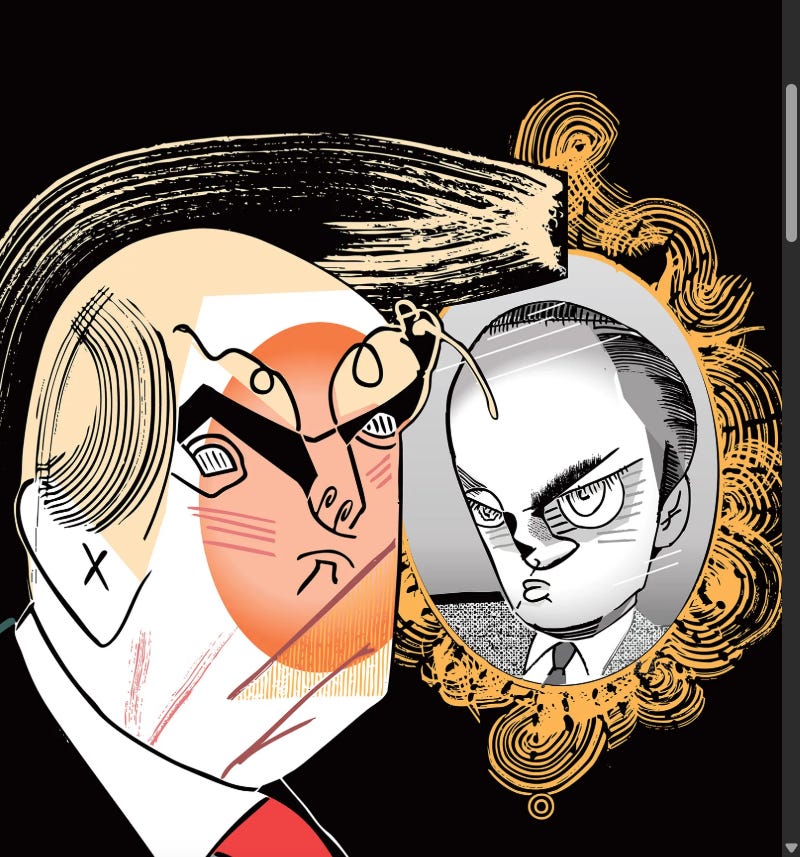
Illustration: Trump and Roy Cohn, New York Review of Books.
By Carl Davidson
LeftLinks Newsweekly, Sept. 18, 2026
In the final forty‑five days before a national election, our country enters a kind of moral turbulence. The air thickens with sound bites, our mailboxes are stuffed, and the stakes sharpen.
The old routines of politics — the speeches, the rallies and town halls, the endless commentary — begin to fall away. What remains is the elemental question of democratic power: who will show up, and who will not.
Tighten your seatbelts. It’s going to be a bumpy ride.
For those of us committed to defending the liberties and livelihood of the rainbow working class and its allies — the people who keep the country running but rarely receive its rewards — the path ahead is clear. These last weeks are not about disembodied abstract persuasion. They are about GOTV: Getting Out The Vote, especially among the people who already agree with us on the core issues but have not yet been convinced that their vote matters.
These are the mobilizables: the warehouse worker who has seen wages stagnate while corporate profits soar; the immigrant family living under the shadow of ICE’s most punitive policies; the young person who opposes war abroad but feels powerless to stop it; the retiree who believes corruption has hollowed out the institutions meant to protect them. They are not apathetic. They are not ignorant. They are simply unconvinced that the political system recognizes their existence.
To reach them, we must break the spell of cynicism and powerlessness that has settled over so many communities. And to do that, we must do two things. First, we must show that times are changing — that social and political realities are not frozen in place, that history is not a mausoleum but a living field of struggle. Second, we must convince people that they have agency, and that when they act in solidarity with others who share their plight and commitments, they can wield real clout.
But to be convincing, we must be honest. Tell no lies. Claim no easy victories. The truth is powerful enough.
Our adversaries — President Donald Trump’s MAGA bloc — face the opposite problem. They face a dreadful dilemma. They must defend a record that has grown increasingly difficult to justify to anyone with a basic awareness of the country’s condition. When policies deepen hardship, when institutions are bent toward personal loyalty rather than public service, when corruption becomes a recurring theme rather than an aberration, the MAGA base starts to shrink, and the terrain becomes hostile even to the most disciplined political machine.
So the battlefield shifts. When a record cannot be defended, other tools emerge. Get prepared for all varieties of dirty tricks.
One batch of dirty tricks is already coming from Trump’s allies in the Kremlin. It’s an encore performance. It was never a ‘hoax,’ but now it’s enhanced by AI.
Recent tracking by independent researchers, including Antibot4navalny and Clemson University, has documented a coordinated Russian disinformation campaign code‑named Matryoshka targeting current Democratic congressional candidates. According to these researchers, the operation has deployed a mix of AI‑manipulated content and fabricated news reports to sow confusion and distrust.
One tactic involves purchasing authentic videos from actors and celebrities through the Cameo app, then doctoring them with artificial intelligence to make it appear as though the celebrities are smearing specific Democratic candidates. Another involves deepfaked CNN‑style news segments targeting figures such as Georgia Senator Jon Ossoff and Texas Senate candidate James Talarico. These are not rumors. They are documented operations, part of a broader pattern of digital interference that has been observed in multiple election cycles.
Independent analysts and intelligence agencies have widely studied foreign involvement in U.S. politics through disinformation, as well as U.S. interference elsewhere abroad. They were never “hoaxes,” and while their precise impact is debated, their existence is not. When political actors cannot defend their record, they often turn to distortion and lies. When they cannot expand their coalition and its goals, they often try to slander and depress someone else’s.
The strain on democratic institutions is visible elsewhere too. The recent Supreme Court setback for MAGA on mail ballots — a ruling that narrowed certain protections — was followed by a public attack from President Trump accusing the justices of disloyalty. The ruling matters, but the reaction matters more. When a president frames judicial independence as personal betrayal, the constitutional architecture trembles. By design, the loyalty of judges is to the Constitution and the law, not to a person or party.
But Trump persists. At a rally in Dallas, he led the crowd in a pledge, directing them to raise their right hands and repeat a vow of personal loyalty. The pledge included the line: “I don’t care if I’m registered or not, I’m going to try to cheat like hell, like they do.” Some commentators framed the language as a joke, but political jokes often reveal more than they conceal. They normalize the idea that elections are not civic processes but battlefields where rules are optional.
Fealty, moreover, is a feudal concept, meaning loyalty and submission to a person of superior rank. To shape their methods, our modern mafia drew on the feudal codes of bandit gangs in Italy’s most backward regions. Trump was educated at an early age in these codes through his relationship with Roy Cohn, lawyer to both the mob and Senator Joe McCarthy.
Meanwhile, back in D.C., FBI head Kash Patel — a close ally of Trump — recently refused to commit that FBI agents would not be sent to polling places. The central legal precedent here is 18 U.S. Code § 592, enacted in 1865, which makes it a felony for any federal official to order “troops or armed men” to a place where an election is being held. The law exists for a reason: today, federal force at polling sites is incompatible with free elections.
But violating norms has never been a barrier for Trump. That is why vigilance is not paranoia. It is prudence.
So what does this mean for the next forty‑five days? It means organizing with discipline and clarity. It means preparing for the best while planning for the worst. It means understanding that democratic participation is not a ritual but a form of collective self‑defense.
The mobilizables — the people who agree with us on the core issues but doubt their own power — are the hinge. They can shift the balance if they believe their vote is not symbolic but instrumental. They can turn democratic theory into democratic practice.
To reach them, we must speak plainly. We discuss with them how history moves. We discuss how political realities change when ordinary people act. We remind them that solidarity is not a slogan but a force. We discuss how their vote is not a whisper in the wind but a lever — one that only works if they pull it.
And together we learn and relearn an important truth: democracy is not guaranteed. It must be defended, especially when those in power treat it as an obstacle rather than a popular covenant.
The next forty‑five days will be turbulent. But turbulence is not defeat. It is the sign of a system under pressure — and pressure is precisely where democratic agency matters most. Organize. Hope for the best. Prepare to block the worst. And above all, remind people that we are not spectators in this story. We are its players on the field.
The trump gang must do it now
or
Face a 2 year head wind